
India's Semiconductor Boom Is Real and Indian Teens Are Missing It - A Career Guide to Rs 12 LPA Fresher Roles
Quick take
A career guide for Indian teens on semiconductor jobs, fresher salaries, VLSI and embedded roles, and how to start preparing from Class 11.
Explore this topic
Article body
India's Semiconductor Boom Is Real and Indian Teens Are Missing It — A Career Guide to ₹12 LPA Fresher Roles
Every career conversation in my school eventually came back to the same fork: software engineering or something else. Software engineering meant stability, decent starting pay, and a job market large enough that the odds of landing something reasonable were in your favour. Something else was vague. Nobody had a specific second answer. The fork felt binary because it had been binary for twenty years, and everyone's older cousins and parents had navigated it the same way.
There is now a third path that is paying freshers double what IT services pays and that almost nobody in a Class 12 classroom is talking about. India's semiconductor industry. Here's the full picture — what the work is, what the salaries are, what the entry path looks like, and why the window to get in early is narrowing faster than anyone is announcing.
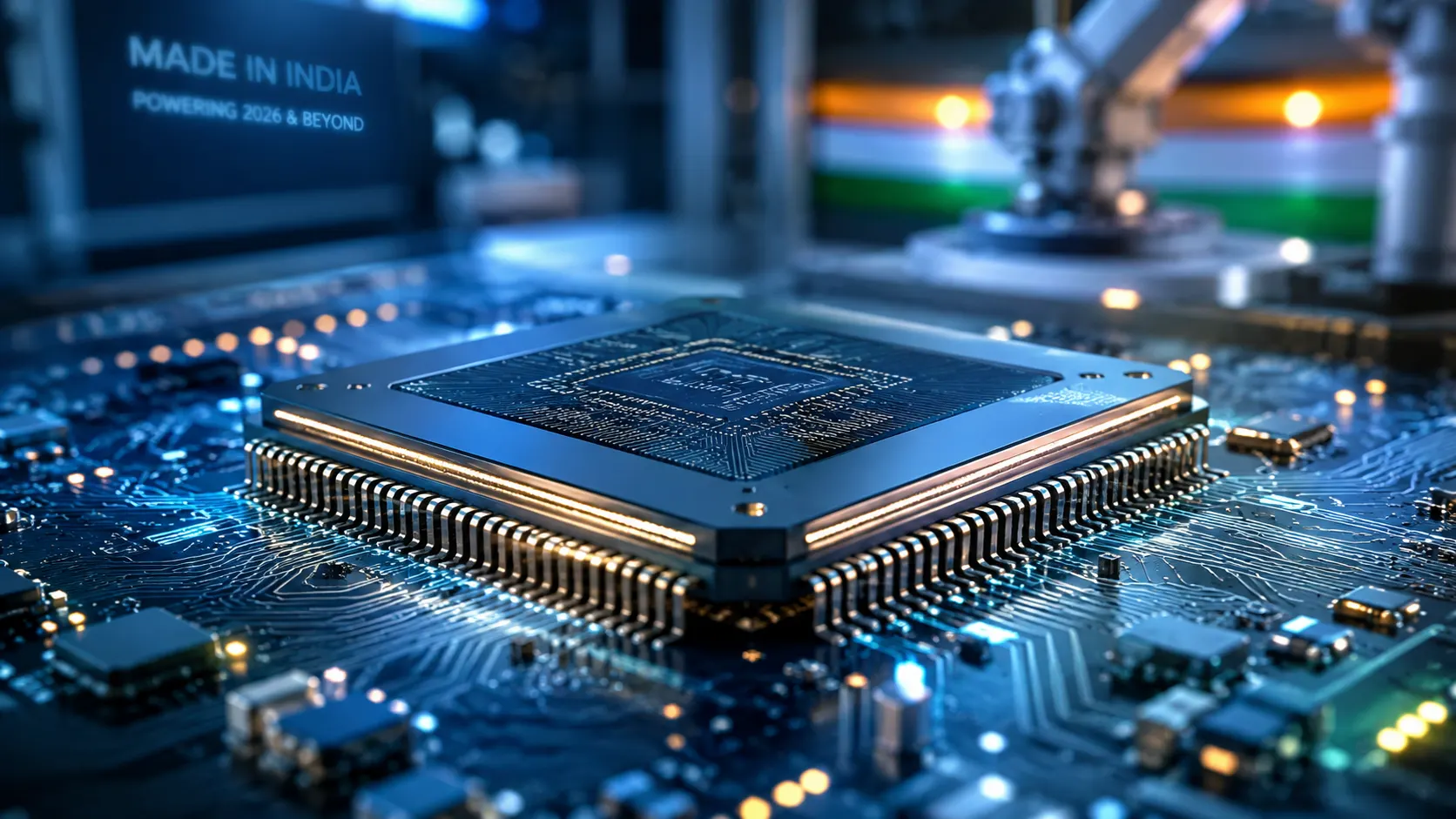
India's semiconductor industry paid freshers ₹6–12 LPA in 2026 vs ₹3–5 LPA in traditional IT. The industry is hiring. The talent pipeline is thin. That gap is the opportunity.
Why This Is Happening Now
The global semiconductor shortage of 2020–2022 made every country realize how fragile a supply chain becomes when chips are made in only two or three places in the world. India's government responded with the Semicon India programme and the PLI (Production Linked Incentive) scheme — committing billions of rupees to incentivise chip design, fabrication, and packaging facilities on Indian soil. The Tata Group broke ground on India's first major chip fab in Gujarat. Micron opened a semiconductor packaging facility in Sanand. Vedanta and others have announced investments.
The consequence that matters for teens right now: these facilities and the design companies supporting them need engineers — specifically VLSI (Very Large Scale Integration) designers, embedded systems engineers, and AI/ML hardware specialists. The existing talent pipeline is thin because Indian colleges haven't produced these graduates at scale. Companies are paying premium salaries to attract the limited pool of people who have relevant skills. That premium is ₹6–12 LPA for freshers versus the ₹3–5 LPA that traditional IT services offers. That gap is not an anomaly — it's a supply-demand mismatch that will persist for at least five to seven years.
What the Work Actually Is
Semiconductor work is not software development in the way most Class 12 students imagine engineering. It sits at the boundary of physics and computing — the literal hardware that makes software possible. Here are the four main roles that freshers enter in India's semiconductor ecosystem in 2026:
VLSI Design Engineer. Designs the actual circuits inside chips — logic gates, memory cells, the electrical pathways that process data. Uses specialised tools like Cadence and Synopsys (industry-standard EDA software). Requires deep understanding of digital electronics, Boolean logic, and timing analysis. Entry path: Electronics Engineering or Electrical Engineering, with VLSI as a specialisation or add-on course.
Embedded Systems Engineer. Writes software that runs directly on hardware — firmware, device drivers, real-time operating systems. If a chip is the brain, embedded engineers write its instincts. Entry path: Electronics, Electrical, or Computer Science Engineering. Strong C programming and understanding of microcontrollers (Arduino, STM32) as practical prerequisites.
Physical Design Engineer. Takes a chip design and maps it onto actual silicon — figuring out how to arrange millions of transistors in the minimum space with the minimum heat. Highly specialised. Entry path: Electronics Engineering with exposure to semiconductor physics and EDA tools. Some companies train freshers in physical design from scratch if the fundamentals are strong.
AI/ML Hardware Specialist. Designs and optimises chips specifically for machine learning workloads — the chips inside AI servers, phones, and autonomous vehicles. The newest and fastest-growing role. Entry path: Computer Science or Electronics Engineering, with demonstrated ML knowledge and interest in hardware acceleration.
The Salary Reality vs IT Services
| Role / Sector | Fresher CTC (2026) | 3-Year Expected | Where Hiring |
|---|---|---|---|
| VLSI Design Engineer | ₹6–12 LPA | ₹15–25 LPA | Qualcomm, Intel, AMD, Tata Elxsi |
| Embedded Systems Engineer | ₹5–10 LPA | ₹12–20 LPA | Bosch, Continental, Texas Instruments, Micron |
| AI/ML Hardware Specialist | ₹8–15 LPA | ₹20–35 LPA | NVIDIA, Google, Apple (via contract labs) |
| IT Services (TCS / Infosys / Wipro) | ₹3–5 LPA | ₹6–10 LPA | Nationwide, bulk hiring |
| Software Dev — Indian Startups | ₹8–20 LPA | ₹15–35 LPA | Bengaluru, Hyderabad, Mumbai |
*Figures from Glassdoor India, Naukri Salary Insights, and industry reports 2025–2026. Semiconductor salaries skew higher for IIT/NIT graduates but Tier-2 college hires are increasingly competitive as companies expand pipelines.
The Entry Path — What a Class 11 Student Should Do Right Now
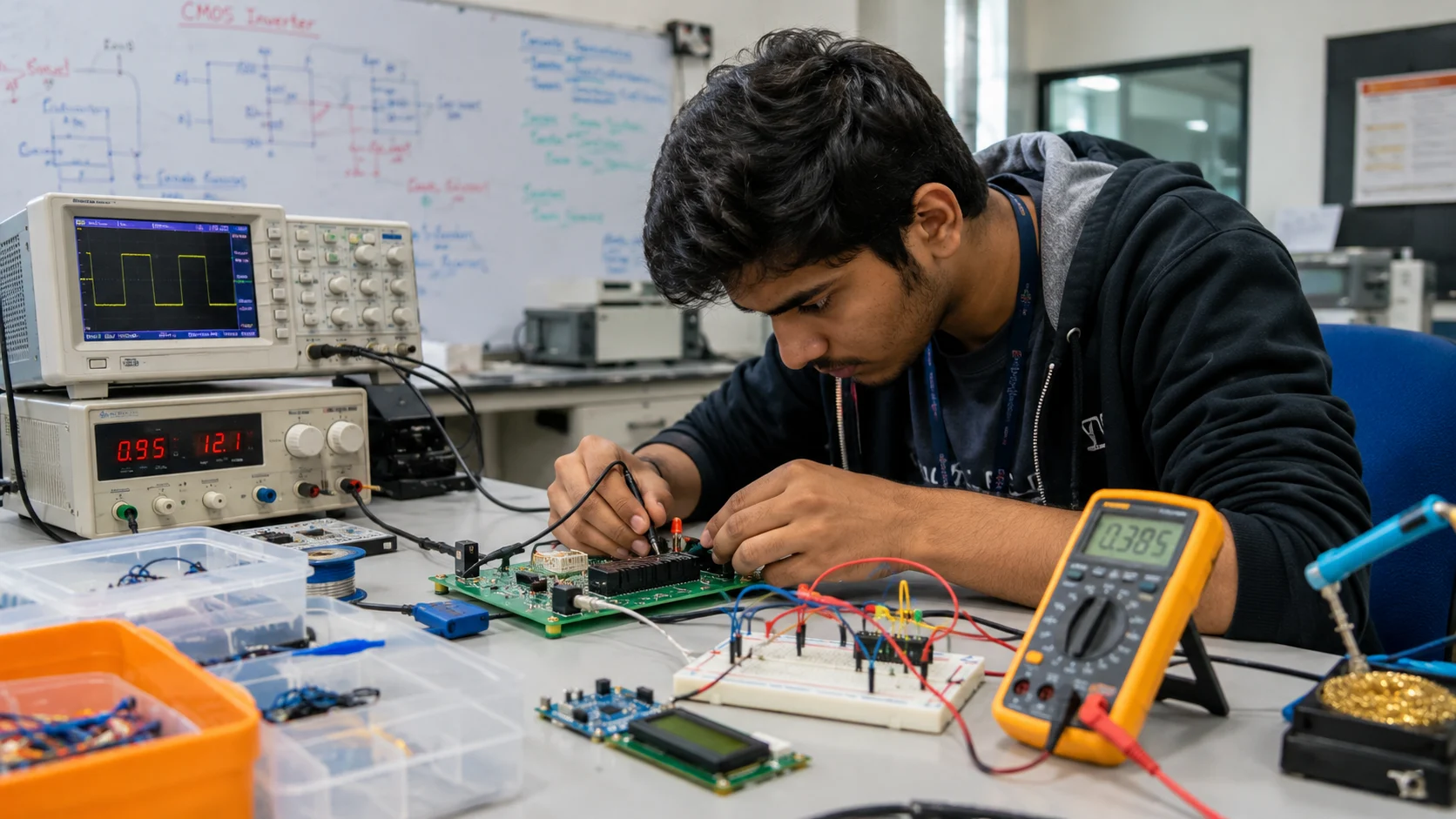
Semiconductor careers are built on physics and electronics fundamentals — the subjects Class 12 students are already studying, often without knowing the career they unlock.
The clearest path into semiconductor work runs through Electronics and Communication Engineering (ECE) or Electrical Engineering (EE) at the undergraduate level, followed by either a specialised semester in VLSI or embedded systems, or a Master's in VLSI Design from institutions like IISc, IIT Bombay, BITS Pilani, or NIT Trichy, which all have strong semiconductor research connections to industry.
But the path that is increasingly viable — and that reflects the industry's actual hiring behaviour — is building demonstrable skills before graduation. Here is what that looks like from Class 11 or 12:
Learn digital electronics seriously, not just for the Class 12 exam. Boolean algebra, logic gates, combinational and sequential circuits — these are the foundations of VLSI design. If you're in the Science stream with Physics and Maths, you're already partially there. Go one layer deeper than the textbook demands.
Start with Arduino or Raspberry Pi. Building something physical — a sensor project, a basic home automation circuit — is the fastest way to develop the hardware intuition that separates candidates who know theory from candidates who can actually work. Both are available in India under ₹3,000 for a starter kit.
Target the VLSI courses that matter. NPTEL (free, IIT faculty) runs excellent digital circuits and VLSI courses. VSD (VLSI System Design) offers an internship programme specifically for Indian students with no prior VLSI experience. Coursera's Hardware Security courses from University of Maryland are accessible at the undergraduate level.
The Indian semiconductor hubs — where the jobs are:
Bengaluru — the dominant hub. Qualcomm, Intel, Texas Instruments, Broadcom, Arm, Micron, Samsung Semiconductor all have significant design centres here. The highest concentration of semiconductor jobs in India.
Hyderabad — growing rapidly. NVIDIA, Google, MediaTek, and Micron's new packaging facility. Government support via Telangana's semiconductor policy making it attractive for new entrants.
Pune — strong in automotive semiconductors. Bosch, Continental, Renesas. As India's EV market grows, Pune's automotive chip design work expands with it.
Chennai — Samsung's semiconductor R&D and several VLSI design firms. Historically strong in hardware manufacturing culture.
Gujarat (Sanand/Dholera) — Tata Semiconductor's fab and Micron's packaging facility. Manufacturing roles rather than design, but significant hiring at scale.
Quick Tips
- Don't wait until college to explore this — the students getting semiconductor internships in their second year of college started building digital electronics projects in Class 12 or first year. The head start is real.
- NPTEL is free and genuinely IIT-quality — the Digital Circuits and VLSI courses on NPTEL (nptel.ac.in) are taught by IIT professors and carry certification that recruiters recognise. Start with "Digital Circuits" by Prof. S. Srinivasan, IIT Madras.
- VSD Internship Programme — VSD (vlsisystemdesign.com) runs a structured internship for absolute beginners in VLSI. Graduates of the programme have landed roles at Qualcomm and Intel India. The programme costs money but less than a semester of any private coaching.
- Physics marks matter more than most students realise — semiconductor physics underlies everything in chip design. A student with strong Class 12 Physics fundamentals learns VLSI concepts faster than one who memorised without understanding.
- The window is open now, not indefinitely — as Indian colleges add VLSI courses and the talent pipeline grows, the salary premium will compress. The students who enter the field in the next three to five years are entering at peak opportunity.
Open NPTEL tonight and search "Digital Circuits."
Enroll in the IIT Madras course. It's free. It's the exact foundation that VLSI design roles build on. If you're in Class 11 with Physics and Maths, you have everything you need to start. The semiconductor industry is hiring at salaries that beat IT services by double and the talent pool is thin. That gap closes as more people find out about it. You're finding out now.
Every chip in every phone and laptop and car was designed by an engineer who started exactly where you are. The difference is they heard about this field before the crowd did.Comments 0
Keep reading
Similar blogs by topic

Study in Europe or Singapore for Less Than a Private Indian College — The Guide Nobody Showed You
A practical guide for Indian students comparing the real costs of studying in Germany, Norway, France, the Netherlands, and Singapore against private colleges in India.

Study in Europe After Class 12 — How Indian Teens Are Getting Bachelor's Degrees Abroad for Less Than a Private Engineering College
A practical guide for Indian Class 12 students exploring Europe, with tuition-free countries, admission steps, language tests, costs, and a realistic comparison with Indian private colleges.

The 5 Platforms Where Indian Teens Are Actually Learning Real Skills in 2026 — Ranked Honestly
An honest ranked list of the 5 best free skill-learning platforms for Indian teens in 2026, including TeenIcon, Khan Academy, freeCodeCamp, and more.