
Become a Prompt Engineer at 18 - The Rs 15 LPA Career Indian Teens Are Quietly Entering Without a Degree
Quick take
A practical guide for Indian teens on becoming a prompt engineer, building a portfolio, understanding the role, and finding AI jobs without a degree.
Explore this topic
Article body
Become a Prompt Engineer at 18 — The ₹15 LPA Career Indian Teens Are Quietly Entering Without a Degree
Two years ago someone mentioned prompt engineering at a career counselling session at my school. Half the room laughed. The counsellor moved on quickly. The joke was reasonable — in 2023, writing prompts for chatbots didn't feel like it warranted a salary, let alone a career. In 2026, an entry-level prompt engineer at an AI-first Indian startup earns between ₹12 and ₹18 LPA. The role exists, the hiring is real, and the entry path — for the first time in a serious Indian tech career — does not require a college degree.
This isn't a LinkedIn influencer's "future of work" post. It's a practical breakdown of what prompt engineering actually involves, what separates it from casual ChatGPT use, what a portfolio looks like for an 18-year-old applying for it, and which Indian companies are hiring without a traditional credentials requirement. If you've been told the only path to a well-paying tech career is engineering college, this is what the other path looks like.
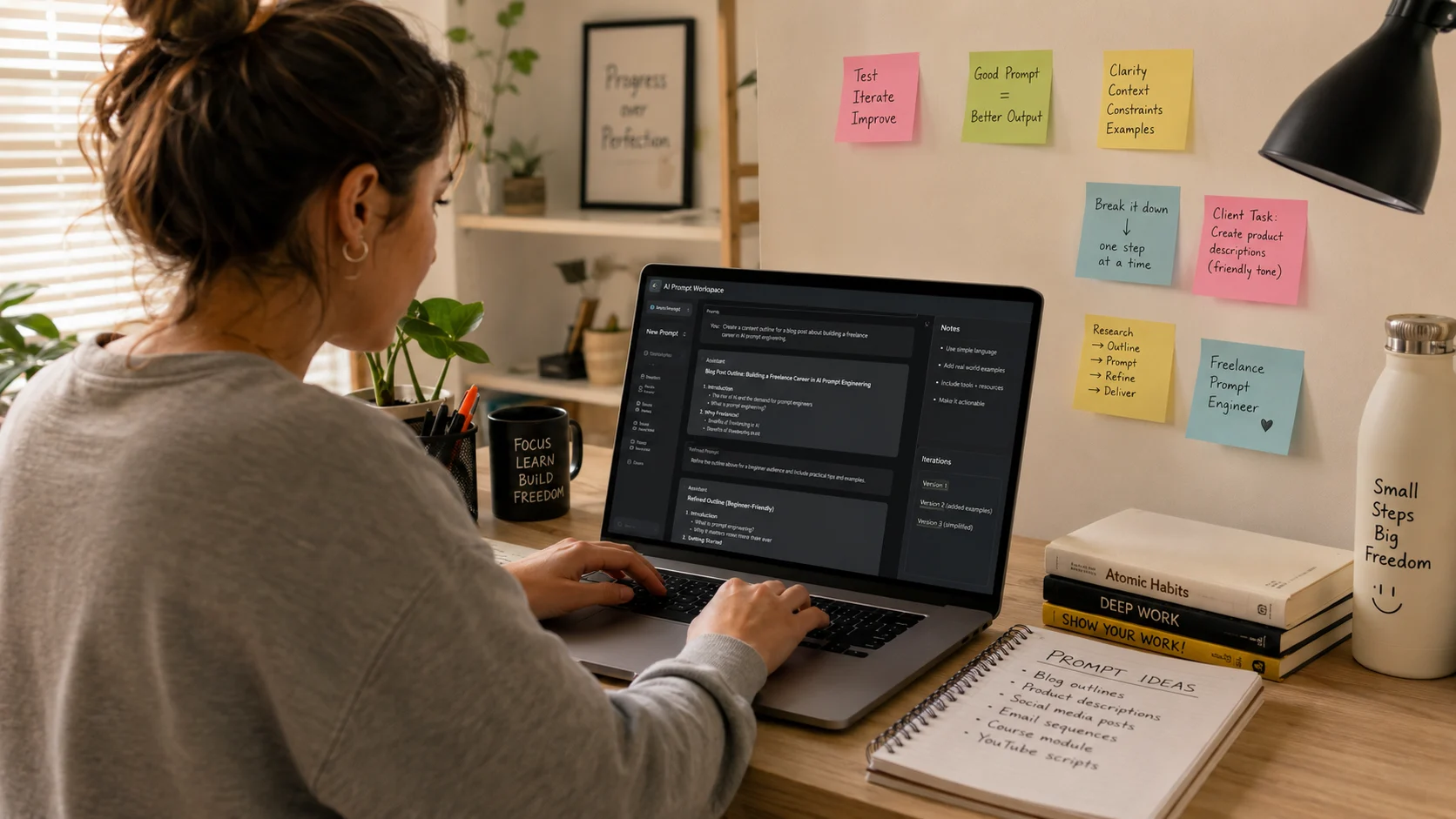
Prompt engineering in 2026 is not writing clever questions for chatbots. It is a structured technical discipline with evaluable outputs and a real salary range.
What Prompt Engineering Actually Is — Not the Meme Version
The meme version of prompt engineering is: type better sentences into ChatGPT and get paid for it. This is about as accurate as describing software engineering as "type stuff into a computer." The real job involves four distinct disciplines that most casual AI users have never touched.
System prompt design. Almost every AI product companies build sits on top of a base model (GPT-4o, Claude, Gemini) with a system prompt — hidden instructions that shape how the model behaves for that specific product. Writing, testing, and iterating on system prompts is technical work that requires understanding how models respond to different instruction types, how to prevent jailbreaks and hallucinations, and how to maintain consistent behaviour across different user input patterns. A well-written system prompt for a customer service AI can reduce hallucination rates by 60% compared to a poorly written one. This is measurable, improvable craft.
Chain-of-thought and few-shot prompting. Telling a model what to do is less effective than showing it how you want it to reason. Few-shot prompting provides examples of input-output pairs that teach the model the pattern. Chain-of-thought prompting asks the model to reason through problems step by step before answering. These techniques dramatically improve output quality on complex tasks — and using them effectively requires understanding why they work, not just that they do.
Output evaluation and red-teaming. Building prompts is only half the job. The other half is systematically testing them for failure modes — edge cases, adversarial inputs, situations where the model confidently produces wrong output. This is called red-teaming and it's increasingly its own specialisation within AI safety and product development. Many Indian AI startups are hiring specifically for this role.
Prompt pipelines and orchestration. Complex AI products chain multiple model calls together — one model extracts information, another reasons about it, another formats the output. Building and debugging these pipelines requires understanding how information flows between steps and where errors compound. Tools like LangChain, LlamaIndex, and CrewAI are the standard toolkit.
The Salary Reality in India in 2026
| Role | Experience Level | India CTC Range |
|---|---|---|
| Junior Prompt Engineer | 0–1 year / fresher with portfolio | ₹10–18 LPA |
| AI Product Prompt Engineer | 1–3 years | ₹18–30 LPA |
| AI Safety / Red-Team Specialist | 1–2 years (specialised) | ₹20–35 LPA |
| Traditional IT Services Fresher | 0 years / degree | ₹3–5 LPA |
| Software Engineer (Indian startup) | 0–1 year | ₹8–20 LPA |
*Figures from LinkedIn Salary Insights India, Glassdoor, and verified job postings on AngelList India and Cutshort as of Q1 2026. The fresher range assumes a demonstrable portfolio — not just a degree.
The Portfolio — What It Looks Like at 18
The credential that gets you hired in prompt engineering is not a degree or a certification — it is a documented portfolio of prompt work with measurable results. Here's what a credible entry-level portfolio contains:
One system prompt project with before/after documentation. Choose an AI product category (customer service, study tutor, code reviewer, content generator). Build a system prompt from scratch. Test it across 50+ inputs. Document where it fails, revise it, test again. Write up the methodology and results. This one project, done properly, demonstrates more relevant skill than any certification.
A red-teaming case study. Take any publicly available AI chatbot. Systematically attempt to make it produce incorrect, harmful, or off-character outputs. Document your methodology, what worked, what didn't, and what the prompt architecture flaws were that enabled the failures. This is the exact work AI safety teams at Indian startups are paid to do — and demonstrating you can do it independently shows both technical and analytical skill.
A few-shot and chain-of-thought demonstration. Choose a complex task — medical triage classification, legal clause extraction, financial report summarisation. Build three versions: zero-shot, few-shot, and chain-of-thought. Run identical test inputs through all three. Document the performance difference quantitatively. This shows you understand the core techniques at a mechanistic level, not just conceptually.
All of this is buildable in three months using free tools — GPT-4o's free tier, Claude's free tier, Google Gemini's free API. None of it requires a college lab or a company to give you access. A laptop, a systematic mindset, and three months of deliberate practice produce a portfolio that hiring managers at AI startups can evaluate immediately.
Which Indian Companies Are Hiring Without Traditional Credentials
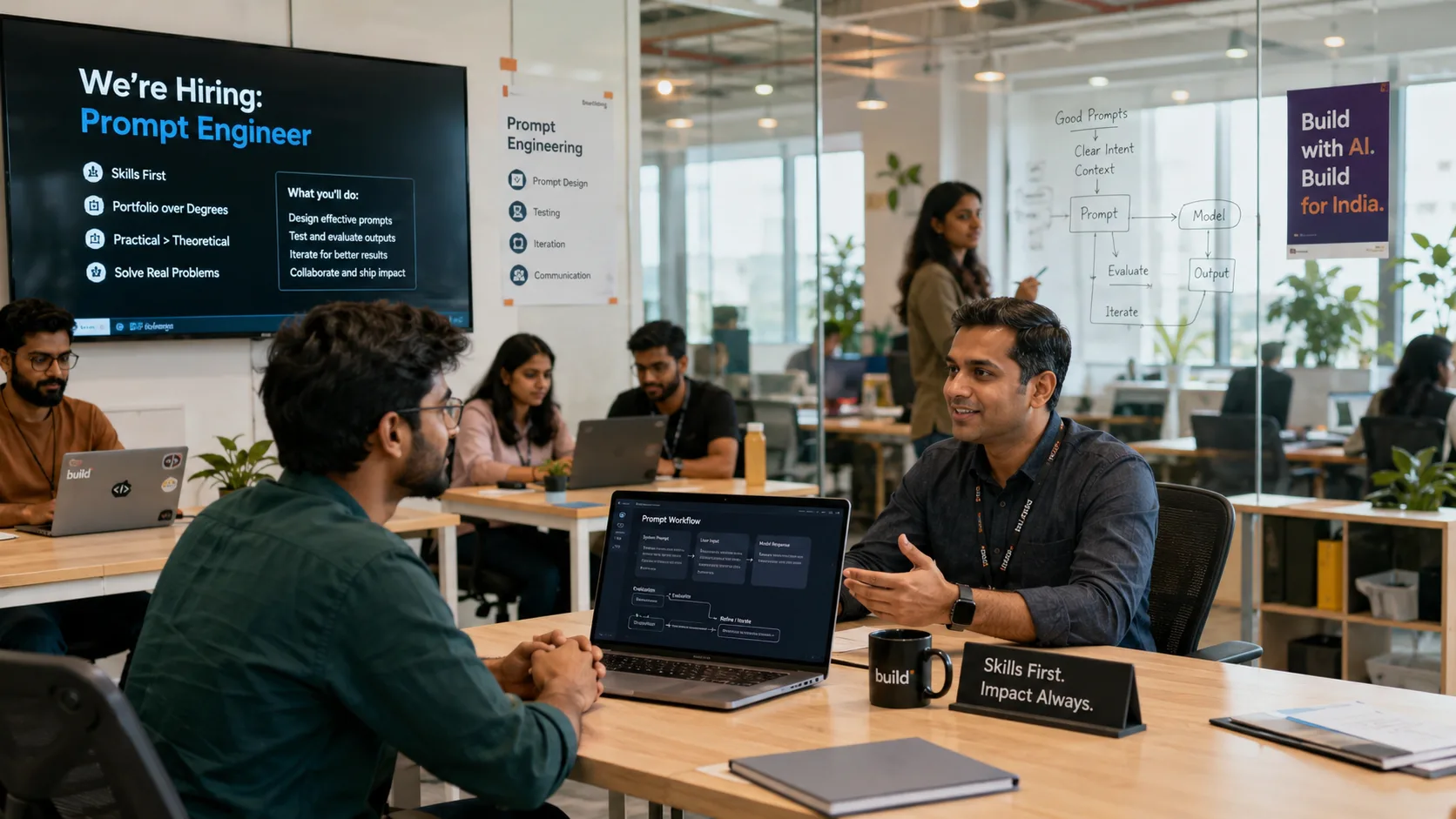
The Indian companies hiring prompt engineers without degree requirements are clustered in Bengaluru, Hyderabad, and Mumbai — and increasingly, remote-first.
The honest answer is that degree requirements in prompt engineering are soft and negotiating them down with a strong portfolio is realistic. The companies where this is most consistently true:
AI-native Indian startups (Sarvam AI, Krutrim, Gnani.ai, Yellow.ai, Haptik) — These companies were built around language models and their hiring culture evaluates demonstrated skill first. Several have explicitly hired 19 and 20-year-olds with strong portfolios into junior AI roles. Search their job postings on AngelList India and Cutshort — both platforms show which roles are open to non-traditional candidates.
AI product teams at Indian unicorns (Razorpay, PhonePe, Meesho, Zepto) — These companies are building AI features into existing products and need prompt engineers to work on specific product integrations. The degree requirement in job postings is frequently listed as "preferred" rather than "required" — which means it is negotiable with strong alternative evidence.
Global companies with India offices hiring remotely — Anthropic, OpenAI, and several US AI startups post roles that are India-remote and evaluate applicants entirely on portfolio. These roles pay in USD equivalents and are the highest-compensated entry points in the field.
Free resources to build the skill from scratch:
Prompt Engineering Guide (promptingguide.ai) — The most comprehensive free resource on prompt engineering techniques. Covers zero-shot, few-shot, chain-of-thought, self-consistency, and tree-of-thought prompting with worked examples.
DeepLearning.AI short courses (deeplearning.ai) — Several free courses on prompt engineering for developers, LLM application development, and red-teaming. Andrew Ng's courses are genuinely well-structured for self-learners.
Anthropic's prompt engineering documentation — The most technically specific public documentation on how to engineer prompts for Claude. Translates well to other models. Free at docs.anthropic.com.
LangChain documentation + GitHub — For building prompt pipelines. The documentation has worked examples. The GitHub has community-built projects to learn from and contribute to.
AngelList India and Cutshort — The two Indian job platforms where AI startup roles post most actively. Set alerts for "prompt engineer," "AI product," and "LLM" roles. Apply to every role where the posting says "portfolio considered" or "experience preferred."
Quick Tips
- Build in public — post your prompt experiments on Twitter/X and LinkedIn as you do them. "I tested three prompting approaches on the same task, here's what I found" is the kind of content that gets noticed by hiring managers at AI startups before you've applied anywhere.
- Specialise in one domain — a prompt engineer who knows legal document analysis, or medical triage, or financial modelling is more valuable than a generalist. Pick the domain you can actually learn from free resources and build your portfolio within it.
- Learn to evaluate quantitatively — "this prompt works better" is an opinion. "This prompt reduced hallucination rate from 23% to 8% across 100 test cases" is evidence. Evaluation methodology is the skill that separates senior prompt engineers from beginners.
- The job title is evolving — you'll find this work listed as "AI Prompt Engineer," "LLM Engineer," "AI Product Specialist," "Conversational AI Designer," and "AI Quality Engineer." Search for all of them.
- Three months of deliberate practice beats three years of passive use — most people who use ChatGPT daily are not building the systematic skills that are hired. Deliberate practice means testing hypotheses, documenting results, and revising based on evidence.
Open promptingguide.ai tonight and read the first three sections.
Tomorrow, pick one AI tool and design one system prompt for one specific task. Test it twenty times. Write down where it fails. That's Day 1 of your portfolio. In three months, you have documented evidence of a skill that Indian startups are paying ₹12–18 LPA to access. The degree is not what they're buying. The demonstrated skill is. Start building the evidence.
The people getting hired into AI roles at 18 didn't wait for college to give them permission. They built the portfolio first.Comments 0
Keep reading
Similar blogs by topic

Study in Europe or Singapore for Less Than a Private Indian College — The Guide Nobody Showed You
A practical guide for Indian students comparing the real costs of studying in Germany, Norway, France, the Netherlands, and Singapore against private colleges in India.

Study in Europe After Class 12 — How Indian Teens Are Getting Bachelor's Degrees Abroad for Less Than a Private Engineering College
A practical guide for Indian Class 12 students exploring Europe, with tuition-free countries, admission steps, language tests, costs, and a realistic comparison with Indian private colleges.