
Crack the JEE/NEET Active Recall Method - How Top Rankers Actually Study (Hint: It's Not More Hours)
Quick take
A practical JEE and NEET study guide explaining active recall, spaced repetition, PYQs, Anki, and the weekly method top rankers use.
Explore this topic
Article body
Crack the JEE/NEET Active Recall Method — How Top Rankers Actually Study (Hint: It's Not More Hours)
I spent Class 11 studying the way every coaching class told me to: read the chapter, make notes, revise the notes, do practice questions at the end. Organised. Thorough. The kind of approach that looked like studying even when it wasn't. My mock test scores plateaued somewhere in the mid-range and stayed there for four months regardless of how many hours I logged. The method was producing the same result on repeat and I kept expecting different output because I was visibly putting in more input.
The turn came when a senior who had cracked JEE Advanced in the top 200 described his actual daily method. It was the opposite of mine in one crucial way: he solved questions before fully understanding the concept, not after. The discomfort of attempting something he didn't yet know forced his brain to identify its own gaps — which he then went to the textbook to fill, specifically and immediately. Read → Understand → Solve had been replaced by Attempt → Fail → Understand the specific failure → Retain. Here's the method in full.

Top rankers consistently describe a different method than what coaching classes prescribe. The difference isn't hours — it's the sequence of reading and attempting.
What Active Recall Actually Is — and Why Passive Study Doesn't Work
Active recall is the practice of retrieving information from memory under conditions of uncertainty — not recognising it when you see it highlighted in your notes, but actually producing it from scratch. The difference matters because JEE and NEET questions are designed to test production, not recognition. "Which of the following is correct" is a recognition task. "A block of mass m is placed on an inclined plane of angle θ with coefficient of friction μ. Find the acceleration." is a production task. Passive reading and note-taking build recognition. Active recall builds production.
The research on this is not new — psychologists have known since the 1930s that the testing effect (attempting recall before studying) produces significantly stronger long-term retention than repeated reading of the same material. What's new is applying this systematically to the specific demands of JEE and NEET, where the questions test the same concepts in endlessly varied contexts.
The Method — Exactly How It Works
The core sequence flips the standard coaching approach:
Standard coaching sequence: Read the NCERT chapter → Watch the teacher's explanation → Make notes → Do module questions → Revise before the test.
Active recall sequence: Skim the chapter headings and key terms (5 minutes) → Attempt 3–5 questions from the chapter without having read it in detail → Note exactly where and why you failed → Read specifically to understand those failure points → Attempt 5 more questions → Identify new failure points → Fill those gaps → Attempt a full chapter test.
The discomfort of attempting questions before you feel ready is the mechanism, not a bug in it. The brain encodes information more durably when it has first tried and failed to retrieve it — this is called the desirable difficulty effect, and it's why open-book revision produces weak exam performance while closed-book testing produces strong retention.
Applied to JEE Physics — Rotational Motion
What most students do: Read NCERT Chapter 7 completely. Make notes on moment of inertia, torque, angular momentum. Add the formulae to a formula sheet. Do the chapter exercises. Score 60–70% on the test.
Active recall approach: Skim headings only (moment of inertia, torque, conservation of angular momentum, rolling motion). Attempt 3 JEE Previous Year Questions on rolling motion without having read the section. Fail at the rolling condition (v = Rω) and the correct expression for total KE. Go specifically to those two sections. Read until those two concepts are clear. Attempt 5 more PYQs. Identify whether energy conservation or torque application is the failure point now. Fill that specific gap. Score 85–90% on the full chapter test.
The difference: you spent the same or fewer total hours, but the hours were spent on actual gaps rather than re-reading things you already partially understood.
The Spaced Repetition Layer — What Keeps Concepts From Fading
Active recall solves the initial learning problem. Spaced repetition solves the forgetting problem. The two work together. Without spaced repetition, even material learned through active recall fades — you understand rotational motion in November and draw a blank in March when the same concept appears in a full mock paper.
Spaced repetition is the practice of reviewing material at increasing intervals — Day 1, then Day 3, then Day 7, then Day 21. The review on each interval is not re-reading: it's another active recall attempt. Can you solve a new problem using this concept without looking at notes? If yes, schedule the next review further out. If no, bring it back to Day 3.
The free app Anki does this automatically. Create a card for each concept with a problem on the front and the solution method on the back — not the formula, the method. "A particle moves in a circle of radius R. When does angular momentum change?" The app schedules each card based on how confidently you rated your recall. Install it, create 10 cards per chapter, and run your due cards every morning before your coaching session. The initial setup takes longer than passive reading. The retention at the end of the year is not comparable.
The Weekly Structure That Makes This Sustainable
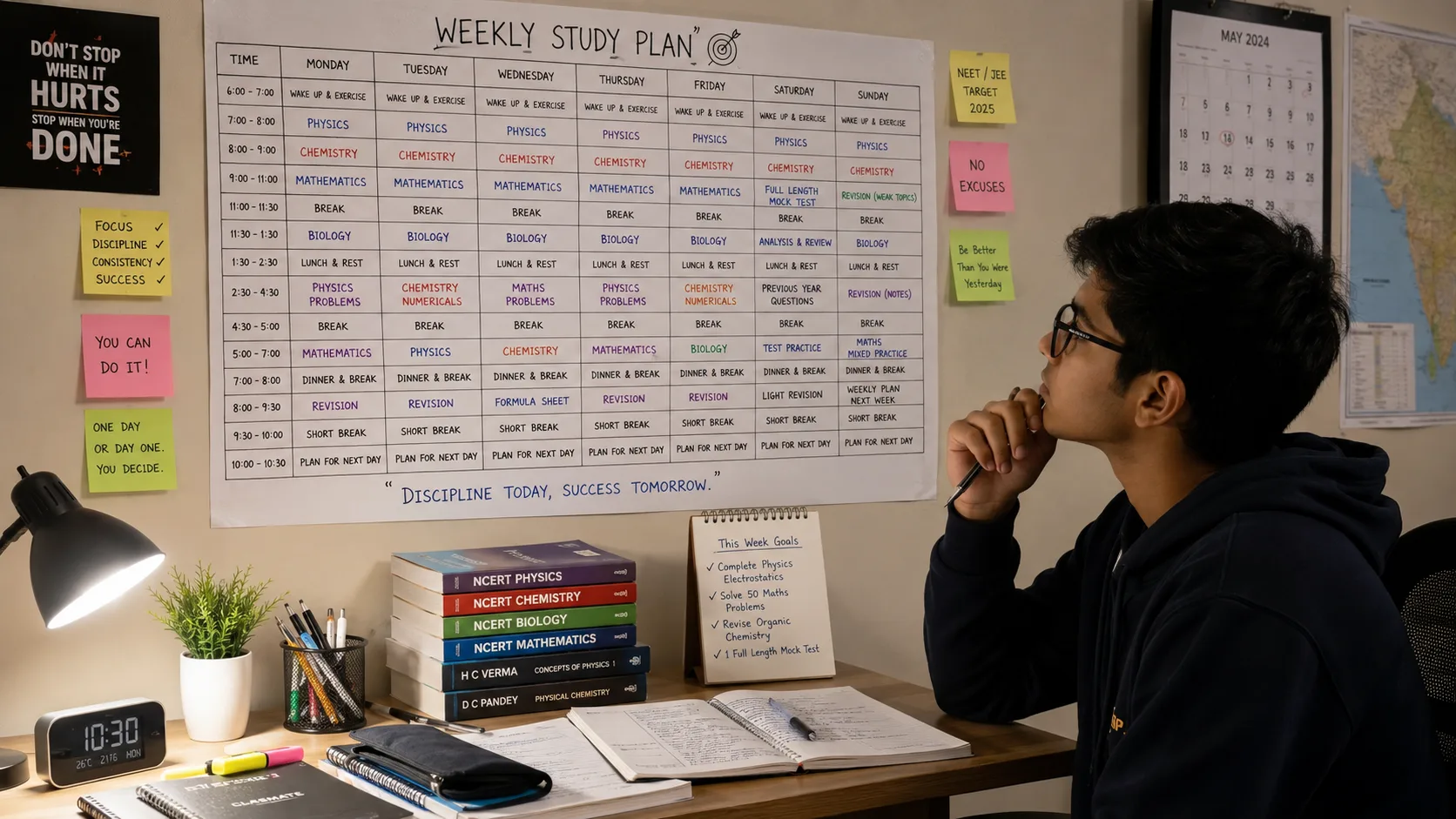
The weekly structure matters as much as the method. What you do on Sunday determines how much Friday's mock test actually teaches you.
The method only works if the week is structured around it. Here's the weekly template that top rankers consistently describe in different variations:
Monday to Friday — Coaching + active recall per chapter. After each new chapter covered in coaching, do at least 5 PYQs (Previous Year Questions) from that chapter before doing anything else. Not module questions — actual JEE or NEET PYQs, because the question phrasing in PYQs is the actual target you're preparing for. Note every question you get wrong or guess correctly without understanding. These wrong questions are your Anki card queue for the evening.
Saturday — Full-length mock test, timed, under exam conditions. One complete mock, no interruptions, correct timing, correct subject order. Saturday mock tests are the most important part of the week — not the coaching, not the module practice. The mock reveals which chapters' active recall work is holding under pressure and which isn't. Without the weekly mock, you have no real-time feedback on your method.
Sunday — Error analysis, not more solving. Go through every wrong answer from Saturday's mock. For each wrong answer: was it a concept gap, a calculation error, or a time management failure? Each category has a different fix. Concept gap → add to Anki, redo the chapter's active recall sequence. Calculation error → identify the step where the error occurred and practise that specific operation. Time management failure → no fix needed in content; the fix is in how you distribute time across the paper in next Saturday's mock.
The specific differences between JEE and NEET active recall approaches:
JEE (Advanced and Main): Focus active recall on problem-solving variation — same concept, different question frames. The JEE paper tests whether you can apply a concept in a context you've never seen before. Your recall practice must include novel problems, not just PYQs. PYQs teach the pattern; novel problems test whether you actually understand the concept independent of pattern.
NEET: Focus active recall on factual density — Biology NEET questions test specific factual recall at a level of detail that requires Anki-style spaced repetition more than novel problem-solving. The correct NEET Biology approach is high-volume Anki deck (3,000+ cards across Biology) combined with active recall on diagram labelling and exception-case recall (the plant that does X differently from all others, the hormone with the unusual function). Chemistry and Physics NEET approach is similar to JEE Main: concept application via PYQs.
Shared principle for both: Sunday error analysis is non-negotiable. The mock is only useful if you spend more time analyzing it than you spent taking it.
Quick Tips
- PYQs before module questions, always — coaching module questions are useful but they're designed to teach concepts sequentially. PYQs are the actual target. Build your recall around what has actually appeared in the exam, then use modules to fill gaps.
- Anki card format that works for JEE/NEET — Front: "Derive the expression for [concept] from first principles." Back: the derivation steps. Not the formula — the steps. A card that tests recognition of a formula is not a JEE-level card.
- The 48-hour rule for new concepts — any concept taught in coaching should be actively recalled within 48 hours, not at revision time before the next test. Material recalled for the first time 3 days after initial exposure is retained significantly better than material first recalled at revision time 2 weeks later.
- Coaching attendance doesn't equal learning — sitting in a coaching class is passive receipt of information. The learning happens in the hour after coaching when you attempt questions on the concept before you feel fully ready. That hour is more valuable than the coaching session itself.
- Your wrong answers are more valuable than your right answers — a question you got right by guessing tells you almost nothing. A question you got wrong precisely identifies the gap. Protect your wrong answer collection. It's a roadmap.
Attempt 5 PYQs on the last chapter covered in coaching — right now, before re-reading it.
The discomfort of not knowing where to start is the method working. Write down exactly where you get stuck. Then open the textbook to that specific section, not the beginning of the chapter. Read until that gap is filled. Attempt 5 more. The cycle of fail-locate-fill-retry is the actual study session. Everything before this was preparation for it.
Top rankers don't study more hours. They study in a direction that forces their brain to do the same work the exam will demand. Now you know the direction.Comments 0
Keep reading
Similar blogs by topic

Self-Study CBSE Class 12 Without Coaching — A Realistic Plan for the 30% Who Can't Afford ₹2 Lakh a Year
A realistic CBSE Class 12 self-study guide for students without coaching, covering NCERT, free resources, subject strategy, and a month-by-month plan.

The Global Korea Scholarship — Why South Korea Is the Most Underrated Destination for Indian STEM Students
A complete Global Korea Scholarship (GKS) guide for Indian teens covering the full package, top universities, application process, and how to apply.

MEXT Scholarship — The Japanese Government Pays for Your Entire Degree and Nobody in India Is Talking About It
A complete MEXT scholarship guide for Indian teens covering the application process, eligibility, stipend details, universities, and how to apply from India.